
- 10, September, 2026
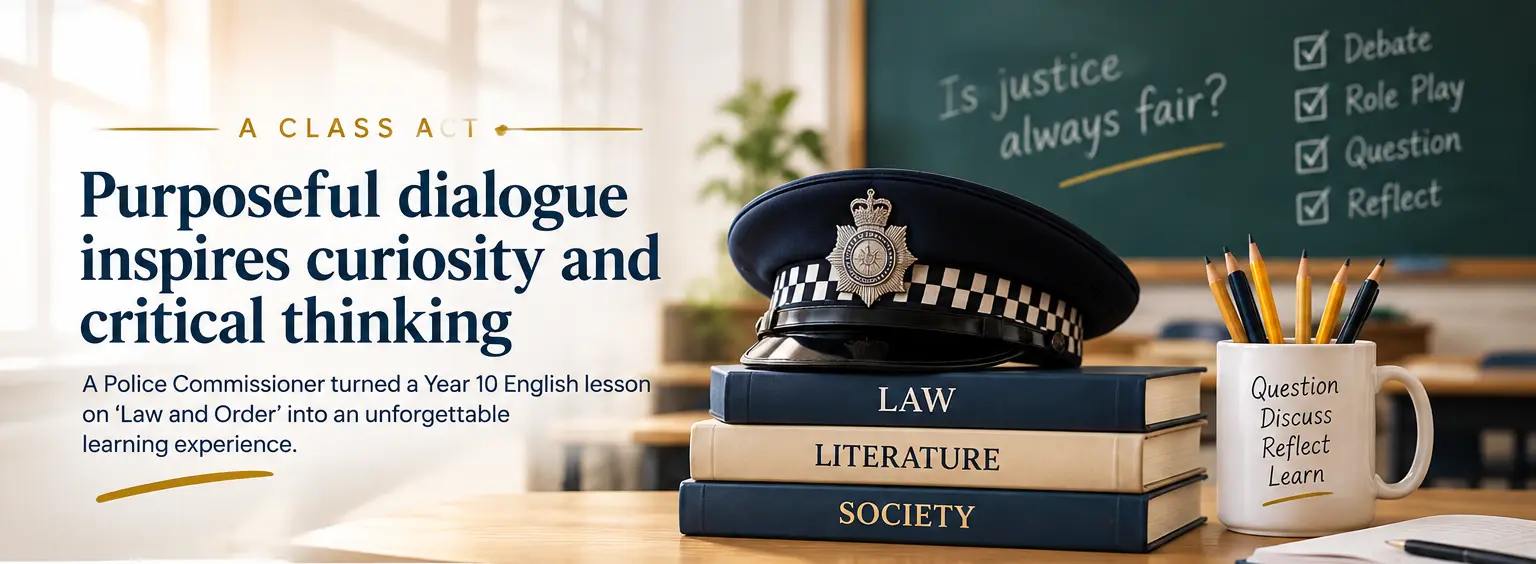
A CLASS ACT
Purposeful dialogue inspires curiosity and critical thinking
A Police Commissioner turned a Year 10 English lesson on ‘Law and Order ‘into an unforgettable learning experience.The Police Commissioner had swapped his duties at the council chamber, for a secondary school classroom? In this real-life case study, inspired by innovative teaching practice, a Year 10 English lesson on “Law and Order” is transformed into an immersive learning experience. Through debate, role play, questioning and reflection, pupils discover that justice is not merely something to read about in literature it is something to question, discuss and understand.
An August Visitor
It was a grey Tuesday morning in late October 2010, and my Year 10B class, had just settled into their English lesson, at Grange School, Lagos. It was a double period lesson that would last one hour and thirty minutes. As pupils drifted through the classroom door, they chatted animatedly about homework, football, social media and the forthcoming mock examinations. A copy of ‘An Inspector Calls’ lay open on each desk, alongside highlighters and exercise books.
Is Justice Always Fair?
Pupils Encounter Guest Teacher.
On the interactive whiteboard, a single question had already appeared: “Is justice always fair?” The question immediately captured the curiosity of several pupils.
“I don’t think it is,” one pupil whispered to her partner.
“It depends on who’s making the rules,” another replied.
I smiled quietly. That was exactly the conversation I had hoped would begin before the lesson had officially started. Today’s learning objective was deceptively simple: To explore how language, power and justice influence society and literature.
Yet the lesson would become unlike any the class had previously experienced, although I had informed the pupils the previous day that a special visitor would be joining them, no one knew who the visitor was. I have been planning this lesson with the visitor about a week ago.
A gentle knock interrupted the morning register. The classroom door opened. Standing in the doorway was a smartly dressed parent wearing a sky-blue suit and carrying a slim leather folder. He was flanked by two equally smartly dressed police officers. As my august visitor made his way into the class, his two police orderlies retreated to another location in the school.
I welcomed the visitor warmly.
“Good morning, everyone.”
“Good morning, sir,” the pupils replied.
“I’d like you to meet Mr Malvin Akpoyibo one of our parents. Outside school he serves as the Police and Crime Commissioner, of Lagos State. He is an Assistant Inspector General of Police, in Nigeria. Today, he has kindly agreed to help us explore our topic on Law and Order.”
For a moment, complete silence filled the room.
Then came an audible chorus.
“Seriously?”
“Wow!”
“Does he catch criminals?”
“Is he an actual police detective, like Inspector Goole?”
Mr Akpoyibo laughed, “I don’t arrest people,” he retorted. “My role is rather different. My job is to work with police leaders, local communities and partner organisations to make Lagos State safer. That means listening carefully, asking difficult questions and making decisions that affect people’s lives.”
Immediately, dozens of hands shot into the air. I resisted the temptation to answer on behalf of the visitor. Instead, he simply smiled and said,
“Excellent. Keep those questions coming, but first, let’s think like investigators.” The lesson had begun.
Learning Through Enquiry
Educational research consistently demonstrates that curiosity is one of the most powerful drivers of learning (Hattie, 2023). Rather than beginning with exposition, effective teachers often provoke uncertainty through carefully chosen questions that require pupils to investigate ideas collaboratively.
This lesson was deliberately designed around enquiry-based learning. Instead of presenting pupils with definitions of justice, law or authority, I invited them to construct their own understanding through dialogue, evidence and reflection.
Activity One:The Preliminary Enquiry
A POLICE STATION
On each table lay a large brown envelope marked:
CONFIDENTIAL CASE FILE
Immediately, excitement spread around the classroom.
Inside every envelope were six pieces of evidence:
- a newspaper headline reporting a jewellery shop robbery;
- a witness statement;
- a CCTV still image;
- extracts from police interview notes;
- a timeline of events; and
- a short newspaper editorial questioning whether the suspect had been treated fairly.
The pupils had only one instruction. “Work out what happened.”
No further explanation was given. Within seconds, groups of four pupils leaned across their desks. One student immediately organised the documents into chronological order. Another carefully compared witness statements. A third questioned whether the CCTV photograph really showed the suspect.
Meanwhile, Mr Akpoyibo quietly circulated between the tables, listening rather than leading. He rarely answered questions directly. Instead, he asked more questions. “What makes you think that?” “Which evidence supports your conclusion?” “Would that information stand up in court?” “How reliable is this witness?” The quality of classroom discussion began to deepen noticeably.
Mercer and Littleton (2007) describe this process as exploratory talk, dialogue in which learners justify opinions, challenge assumptions and build understanding collectively. Rather than competing to produce the “correct” answer, pupils became investigators, testing hypotheses against available evidence.
One group quickly concluded that the suspect must be guilty because his fingerprints had been found near the scene. Mr Akpoyibo paused beside their table. “Interesting conclusion,” he said gently. “Tell me, does finding fingerprints always prove someone committed a crime?”
The pupils looked back at the evidence. One boy frowned. “No…” “Why not?” “Because he could have been there earlier.” “Excellent,” Mr Akpoyibo replied. “So investigators need evidence, but they also need context.”
Across the room, another group noticed inconsistencies between two witness statements. One witness described the suspect wearing a black hoodie. The other insisted he had been wearing a grey jacket. “Someone must be lying,” one pupil declared confidently.
I intervened briefly. “Or…?”
A girl quietly offered another possibility. “They both saw different things because they were standing in different places.” The room fell silent.
Several pupils immediately returned to their documents. That single observation transformed the discussion from certainty to enquiry.
As English teachers know, this shift is crucial. Literature, and indeed life, rarely offers simple answers. Whether analysing Sheila Birling’s moral awakening, Macbeth’s ambition or Inspector Goole’s motives, pupils must learn to evaluate multiple interpretations rather than search for predetermined conclusions.
The classroom had become more than a place of instruction. It had become a community of enquiry.
When Language Shapes Justice
With twenty minutes of the lesson remaining, I projected two newspaper headlines onto the whiteboard.
LOCAL TEEN TERRORISES SHOP OWNER
and
YOUNG PERSON QUESTIONED FOLLOWING INCIDENT
The class immediately noticed the contrast.
“One sounds guilty already,” observed one pupil.
“The other sounds much fairer,” another added.
Mr Akpoyibo nodded thoughtfully. “Words matter,” he said. “In policing, in journalism and in everyday life. The language we choose influences how people think about events long before all the facts are known.”
The discussion that followed linked naturally to the study of persuasive language in English, encouraging pupils to examine how vocabulary, tone and framing shape public perceptions of justice.
The lesson was no longer only about crime or policing; it had become an exploration of language, power and responsibility, themes at the heart of English education.
From Evidence to Justice
When Every Pupil Found Their Voice.
At this juncture, the classroom no longer resembled a conventional English lesson. The pupils were not passively completing comprehension questions or annotating extracts in silence. Instead, they had become investigators, weighing evidence, questioning assumptions and debating interpretations with growing confidence.
I glanced around the room with quiet satisfaction. Every table was alive with purposeful discussion. Pupils who were often reluctant to contribute during whole-class questioning were leaning forward, pointing to evidence sheets, defending interpretations and inviting others into the conversation.
It was precisely the kind of classroom dialogue that Robin Alexander (2020) describes as dialogic teaching, a learning environment in which understanding is co-constructed through purposeful talk rather than transmitted solely through teacher explanation.
Mr Akpoyibo, the Police and Crime Commissioner, returned to the front of the classroom. “So,” he smiled, “have you solved the case?” A chorus of confident voices answered immediately.
“Yes!”
“No!”
“We’re not sure.”
“It depends!”
Mr Akpoyibo laughed. “I like that answer best.”
The pupils looked puzzled. “Why?” one asked.
“Because in policing,” Mr Akpoyibo replied, “certainty without sufficient evidence can be dangerous.” The room fell silent.
It was a simple statement, yet it challenged one of the most common misconceptions among young people, that justice is simply about identifying the guilty person. Instead, Mr Akpoyibo invited pupils to appreciate that justice requires careful reasoning, ethical judgement and an unwavering commitment to fairness.
I then seized the moment. “Today,” I explained, “we’re not just learning about law and order. We’re learning how language shapes justice.”
Activity Two: Inside the Interview Room
I quickly rearranged the classroom furniture. At the front of the room stood two chairs facing one another. A laminated sign read:
POLICE INTERVIEW SUITE
I then explained that each group would nominate one pupil to act as the investigating officer and another to play the suspect. The remaining pupils would become legal advisers and observers, responsible for recording the quality of questioning rather than deciding guilt.
Mr Akpoyibo emphasised one important rule.
“Real investigators never begin with accusations.” Instead, he projected four questions onto the whiteboard:
- What happened?
- What evidence supports that account?
- Can anyone verify your version?
- Is there another explanation?
“No shouting,” he reminded them. “No intimidation. Just questions.”
The first pair nervously took their seats. The investigating officer began confidently.
“Where were you yesterday afternoon?”
The suspect replied calmly.
“Walking home from school.”
“What time?”
“Around four o’clock.”
“Were you alone?”
“No.”
“Who was with you?”
“My cousin.”
The interviewer paused.
Several pupils immediately whispered suggestions.
Mr Akpoyibo intervened gently.
“Don’t ask the next question because it’s on your worksheet.”
He smiled, “Ask it because you’re genuinely curious.”
The pupil thought carefully before continuing. “What made you remember the exact time?”
The suspect hesitated. “Because I stopped at the bakery after football practice.”
I noticed something remarkable. The quality of questioning had immediately improved. Rather than following a script, pupils were beginning to listen carefully before responding.
Mercer and Dawes (2014) argue that genuine dialogue requires participants to adapt their thinking in response to new information. Here, pupils were doing precisely that.
One observer later remarked, “I realised asking good questions is much harder than answering them.”
The lesson then shifted back towards English, as I displayed three witness statements describing exactly the same incident.
Each statement contained different vocabulary.
One witness described the suspect as:
“aggressive”
Another wrote:
“frightened”
A third described him simply as:
“running.”
Mr Akpoyibo addressed the class.
“Can all three witnesses be telling the truth?”
The pupils immediately began debating.
“Running doesn’t mean guilty.”
“But why would he run?”
“Maybe he was scared.”
“Maybe someone was chasing him.”
I then wrote a single word across the whiteboard.
Perspective.
“This,” he explained, “is exactly what we do whenever we study literature.”
“When we analyse Sheila Birling.”
“When we examine Macbeth.”
“When we discuss Inspector Goole.”
“We ask whose perspective we’re hearing, and whose voice might be missing.”
The pupils nodded.
Suddenly, English no longer felt disconnected from real life. Language had become evidence. Vocabulary had become interpretation.
Activity Three: The Courtroom Challenge
Without warning, the classroom transformed once again.
I rearranged several tables to resemble a courtroom.
A sign reading
CROWN COURT
appeared at the front.
Pupils were assigned new roles.
- Judge
- Magistrates
- Defence Counsel
- Prosecution Barrister
- Court Reporter
- Jury
- Witnesses
Mr Akpoyibo explained courtroom etiquette before quietly taking a seat beside the jury rather than leading proceedings himself.
“This court belongs to you,” he smiled.
The prosecution opened confidently.
“Members of the jury, the evidence clearly shows…”
The defence immediately interrupted.
“Objection!”
Laughter filled the room.
I raised an eyebrow.
“On what grounds?” The pupil paused before replying,
“My opponent has made a claim without referring to any evidence.”
Several classmates applauded.
I smiled. “Excellent observation, well done.”
For the next twenty minutes the classroom became a lively yet disciplined forum of persuasion. Pupils quoted witness statements. They challenged assumptions. They questioned reliability.
One juror even requested clarification before reaching a verdict. “I don’t think we’ve heard enough yet.” The maturity of the discussion surprised even Mr Akpoyibo and me. During the plenary, one normally quiet pupil reflected, “I’ve watched courtroom dramas like ‘Garrows Law’ and ‘Justice’ on television, in London, but I didn’t realise how much talking, and listening, lawyers actually have to do.”
Mr Akpoyibo nodded. “Listening,” he replied, “is one of the most important skills in policing.”
Reflection in Action
As the activities unfolded, I recorded brief observational notes in my planner.
Pupil A, usually reluctant to answer whole-class questions, volunteered to act as defence barrister and confidently challenged the prosecution’s interpretation.
Pupil B demonstrated significantly improved use of subject vocabulary, referring to evidence as ‘credible’, ‘reliable’ and ‘circumstantial’.
Pupil C encouraged quieter members of the group to contribute before presenting the team’s conclusion.
These observations reflected more than increased engagement; they illustrated the power of authentic learning experiences to reshape classroom participation.
Kolb’s (1984) theory of experiential learning suggests that learners construct deeper understanding when they actively engage with realistic situations rather than merely receiving information. Likewise, contemporary research on oracy highlights that structured discussion enables pupils to clarify ideas, refine reasoning and develop confidence through purposeful interaction (Voice 21, 2023).
Looking around the room, I noticed that pupils were no longer speaking simply to answer questions. They were speaking to persuade, to reason, to challenge and to understand.
That transformation represented the lesson’s greatest success. It was no longer the visitor who occupied the centre of attention. The pupils did. As the bell approached, Mr Akpoyibo glanced at me. “I think,” he whispered, “they’ve been teaching each other.” I smiled. He could not have asked for a greater compliment.
For a moment, the classroom fell into reflective silence, not because discussion had ended, but because every pupil seemed to recognise that justice is rarely straightforward. It demands evidence, empathy, careful language and the willingness to listen before reaching conclusions, this lesson on ‘Law and Order,’ was emphatically summarized in a typically reflective mode.
Question time
When Curiosity Took Centre Stage.
With the mock courtroom now adjourned and the final verdict delivered, I looked towards the class.
“Before we finish,” I retorted “I think we have one final opportunity that doesn’t happen every day. Mr Akpoyibo has kindly agreed to answer your questions.”
Within seconds, nearly every hand in the room was raised.
Mr Akpoyibo smiled.
“I’ve answered questions from journalists, councillors and police officers,” he declared. “But I suspect Year 10 will be my toughest audience.” The room erupted in laughter.
I arranged the chairs into a semi-circle to create a more conversational atmosphere. Gone was the formal structure of the courtroom simulation. This was now a genuine dialogue in which pupils were encouraged to ask searching questions, challenge assumptions respectfully and listen attentively to one another’s ideas. “Who would like to begin?” I asked.
A pupil seated near the window spoke first.
“Sir what’s the hardest decision you’ve ever had to make?”
Mr Akpoyibo paused before answering.
“The hardest decisions are rarely about choosing between right and wrong,” he replied. “They’re usually about choosing between two imperfect options. In public service, every decision affects real people, so you have to balance justice, compassion and evidence.”
Several pupils quietly wrote those words into their notebooks.
Another pupil followed.
“Do you ever disagree with the police?”
“Yes,” Mr Akpoyibo answered candidly. “Part of my role is to ask difficult questions and hold policing to account. Good leadership isn’t about agreeing with everyone; it’s about ensuring that decisions are fair, lawful and based on evidence.”
I noticed several pupils exchanging thoughtful glances.
Without prompting, one pupil connected the discussion to the class text.
“That’s a bit like Inspector Goole,” he observed. “He keeps asking difficult questions because he wants people to think about responsibility.”
Mr Akpoyibo smiled. “I hadn’t thought of it that way,” he replied, “but I think you’re right, because I read your textbook ‘An Inspector Calls,’ as part of my preparation for this presentation. Sure, you are right.”
The classroom briefly fell silent as pupils recognised that literature and public life were intersecting before their eyes.
A quieter pupil, who rarely contributed during whole-class discussion, cautiously raised his hand. “Do people deserve a second chance?”
The simplicity of the question seemed to affect everyone in the room.
Mr Akpoyibo answered carefully. “I believe many people do. Accountability matters, but so does rehabilitation. One of the greatest responsibilities of any justice system is knowing when punishment alone is not enough.”
I resisted the temptation to intervene. Instead, another pupil responded.
“So justice isn’t really about revenge?” Mr Akpoyibo shook his head.
“No. Justice is about protecting society while treating people fairly and with dignity.”
The conversation began to take on the qualities of what Alexander (2020) describes as dialogic teaching: ideas were not merely exchanged but developed collectively. Pupils listened carefully before responding, referred to previous contributions and refined their thinking in light of new perspectives. The teacher had become a facilitator rather than the dominant voice in the room.
One pupil asked a question that prompted perhaps the most memorable exchange of the morning. “What skill do you think young people need most if they want to make a difference?”
Mr Akpoyibo looked around the classroom before answering. “Learn to listen as carefully as you speak.” He continued: “People often think leadership is about giving speeches. In my experience, leadership begins by listening, to evidence, to communities and to people whose experiences are different from your own.”
I glanced around the room. Every pupil was focused on the discussion.
No one was checking the clock. No one appeared distracted. For a profession that frequently competes with mobile phones and social media for pupils’ attention, such complete engagement was remarkable.
Before bringing the session to a close, I invited pupils to complete one final reflection. ‘Please class write in your exercise books, what you may consider the most important thing you are taking away from today’s lesson?’ Their responses demonstrated not only what they had learned but how they had learned it.
One pupil wrote:
“I realised English isn’t only about analysing books. It’s about analysing people, ideas and the language they use.”
Another reflected:
“The courtroom activity made me understand why evidence matters more than assumptions.”
A third commented:
“Today I learnt that asking better questions helps you become a better thinker.”
Perhaps the most moving response came from a pupil who had seldom volunteered answers during previous lessons.
“Usually I worry about getting the wrong answer. Today I realised there wasn’t just one right answer. That made me more confident to speak.”
For me, as a teacher, this single comment encapsulated the lesson’s greatest success.
My Reflection on this Lesson
As classroom teachers, we often search for innovative ways to make learning memorable. We carefully plan lessons; design engaging resources and differentiate activities to meet the needs of increasingly diverse classrooms. Yet occasionally a lesson reminds us that the most powerful resource available is not a worksheet or digital presentation, but people.
Inviting members of the wider community into school enriches learning in ways that textbooks alone cannot achieve. Professionals bring with them lived experience, authentic stories and practical knowledge that connect classroom learning to the wider world. Their presence demonstrates that the knowledge and skills developed in English lessons extend far beyond examination success; they are essential tools for life.
Reflecting afterwards, I realised that the success of the lesson did not lie simply in the presence of a Police and Crime Commissioner. Had the visitor merely delivered a presentation, pupils would undoubtedly have found it interesting, but much of the educational value would have been lost.
Instead, the lesson was deliberately structured around active participation. Pupils questioned, challenged, negotiated, debated, justified opinions and evaluated evidence. They learned through doing rather than simply listening.
This approach aligns closely with Kolb’s (1984) theory of experiential learning, which argues that meaningful understanding develops through active experience, reflection and application. Similarly, Alexander’s (2020) work on dialogic teaching reminds us that talk is not simply a vehicle for demonstrating learning; it is one of the principal ways in which learning itself is constructed.
The classroom observations recorded during the lesson reinforced this view. Pupils who normally contributed only briefly became increasingly confident in expressing opinions. More able pupils learned to justify arguments with greater precision, while quieter pupils found confidence through collaborative group work before sharing ideas publicly. The quality of vocabulary also improved noticeably as pupils began to use terms such as credibility, bias, reasonable doubt, justice, perspective and accountability naturally within discussion.
Perhaps most significantly, the lesson demonstrated that oracy flourishes when pupils perceive genuine purpose in classroom dialogue. They were not speaking merely because I had asked a question, as their teacher; they were speaking because they wanted to solve a problem, persuade a jury or seek answers from someone whose professional experience gave authenticity to the discussion.
Lesson for English Teachers
Although opportunities to invite professionals into school may not arise every week, the principles underpinning this lesson can be replicated, not just in English alone, but in almost any subject, due to the following:
- Authentic enquiry stimulates curiosity.
- Purposeful dialogue develops critical thinking.
- Role-play encourages empathy.
- Debate strengthens reasoning.
- Questioning promotes independence.
- Reflection consolidates learning.
These principles resonate strongly with current research into dialogic pedagogy and oracy. Mercer and Dawes (2014) argue that productive classroom talk enables learners to construct understanding collectively, while the Oracy Education Commission (2024) has called for spoken language to become a central pillar of educational practice rather than a peripheral skill.
Equally important is the role of community partnerships. Schools do not exist in isolation. Parents, employers, emergency services, charities, artists and civic leaders all possess expertise capable of enriching pupils’ educational experiences. By opening classroom doors to the wider community, teachers create opportunities for pupils to encounter diverse perspectives, challenge stereotypes and appreciate the practical relevance of their learning.
Final Thoughts
As the final bell rang, pupils reluctantly gathered their belongings. Several thanked Mr Malvin Akpoyibo personally before leaving the classroom. Some also shook hands with his son, Kevwe, as they all drifted out of the class. From the flashes of giggles in Kewve’s demean, you can tell how proud he felt of his dad’s Class Act performance.
Others continued discussing the courtroom verdict as they walked along the corridor towards their next lesson. I remained behind for a few moments, quietly collecting the evidence files scattered across the desks. Smiles lingered on faces. Conversations continued beyond the classroom door. The learning had not ended with the lesson; it had simply changed location.
There are days in teaching when success is measured by completed exercise books or improved assessment scores. Then there are days when success is measured differently, by the quality of pupils’ questions, by the confidence with which previously hesitant learners contribute, by the curiosity that follows them out of the classroom and into the wider world. This was one of those days.
Long after pupils had forgotten the details of the fictional investigation, many would remember how the lesson made them feel: trusted to think, encouraged to question and inspired to speak. Perhaps that is the true purpose of English education. Not simply to teach young people how to read great literature or write analytical essays, important though those skills undoubtedly are. But to help them find their own voices, and to use those voices thoughtfully, responsibly and courageously.
If that happened during one ordinary Tuesday morning because a classroom welcomed a parent with extraordinary experience, then the lesson achieved something far greater than its original objective. It became, in every sense of the phrase, A Class Act.
Why This Was A Class Act
Outstanding lessons are rarely memorable because of elaborate resources or theatrical performances. They endure because they invite pupils to think differently. On this occasion, an ordinary Year 10 English classroom became a space where literature met lived experience, where enquiry replaced assumption and where every pupil was encouraged to contribute to a conversation that genuinely mattered.
The Police and Crime Commissioner did not simply answer questions. He modelled thoughtful leadership, respectful dialogue and intellectual curiosity. The pupils did not merely learn about law and order; they experienced how language, evidence and ethical reasoning shape decisions that affect people’s lives.
Most importantly, they discovered that their own voices mattered. Long after the case files have been recycled and the role-play scripts forgotten, many pupils are likely to remember the confidence they gained from speaking, questioning and listening with purpose.
Perhaps that is the enduring lesson for all English teachers. When classrooms become communities of enquiry, when learning is rooted in authentic experience and when dialogue is treated as both a means of learning and an end in itself, English ceases to be simply a subject. It becomes preparation for thoughtful citizenship.
That is why this lesson deserves to be remembered, not merely as an engaging classroom activity, but as A Class Act.
The following term, I invited yet another parent guest, Mrs Fadekemi Olumide-Aluko, a lawyer, educationist and author of the book, ‘Pearls for my Daughter,’ to my Year 8D class. It was an equally intriguing lesson.
References
Alexander, R. J. (2020). A Dialogic Teaching Companion. Abingdon: Routledge.
Department for Education (2014). National Curriculum in England: English Programmes of Study. London: DfE.
Education Endowment Foundation (2021). Improving Literacy in Key Stage Three. London: EEF.
Kolb, D. A. (1984). Experiential Learning: Experience as the Source of Learning and Development. Englewood Cliffs, NJ: Prentice Hall.
Mercer, N., & Dawes, L. (2014). ‘The Study of Talk Between Teachers and Students.’ Oxford Review of Education, 40(4), pp. 430–445.
Oracy Education Commission (2024). We Need to Talk: The Final Report of the Oracy Education Commission. London: Voice 21.
Vygotsky, L. S. (1978). Mind in Society: The Development of Higher Psychological Processes. Cambridge, MA: Harvard University Press.
Voice 21 (2023). The Oracy Benchmarks. London: Voice 21.